



Top Differences Between PPR, PVC & Copper Pipes — Which...
08 Apr 2026 | by admin
24 hours Emergency Services!
Work Time
Everyday 7AM - 6PM
12 November, 2025 | by admin
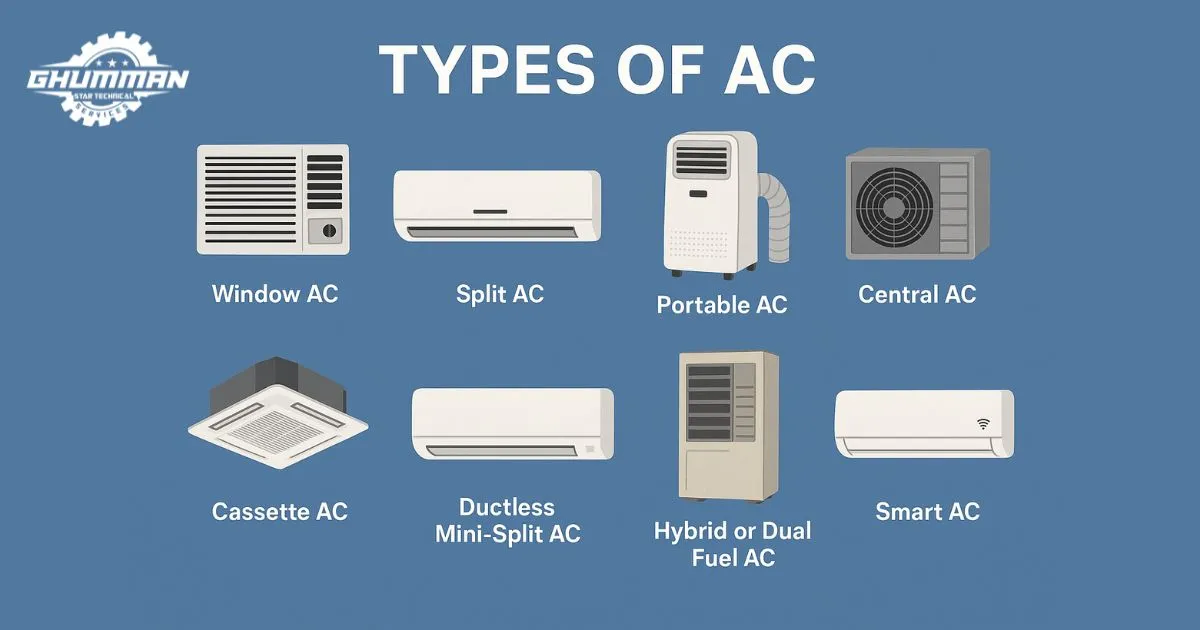
Feeling like you’re melting in the summer heat? 🥵
You’re not alone! Air conditioners have become more than just luxury — they’re a necessity in modern homes. But with so many types of AC available, choosing the right one can be downright confusing. Don’t worry, though — this guide breaks it all down for you in simple, relatable terms so you can chill (literally!) in comfort.
Before diving into the different types, let’s quickly understand what an air conditioner really does.
At its core, an AC works like a refrigerator for your room. It pulls in hot air, passes it through cooling coils filled with refrigerant, and pushes out cool, refreshing air — leaving you relaxed and refreshed.
Every room, home, or office is different. Picking the wrong AC can mean higher electricity bills, poor cooling, and wasted money. The right type, however, ensures comfort, energy efficiency, and peace of mind.
Let’s explore the most common types of AC systems and what makes each one unique.
A window AC is the old-school classic — compact, affordable, and reliable. It’s a single-unit system that fits into your window or a wall opening.
Easy to install and maintain
Budget-friendly
Ideal for small rooms or single spaces
Noisy operation
Blocks your window view
Not suitable for large spaces
The most popular type today, a split AC consists of two parts — an indoor unit and an outdoor compressor. These are connected by pipes and cables.
Silent operation
Energy efficient
Modern design with remote and smart options
Costlier than window ACs
Requires professional installation
Regular maintenance needed
Think of this as your AC on wheels. You can move it from room to room without needing permanent installation.
Mobility and flexibility
Easy to set up
Great for rented apartments
Limited cooling capacity
Louder than other types
Needs frequent drainage of condensed water
If you’ve ever stepped into a big office, mall, or luxury home and felt even cooling everywhere — that’s central AC. It uses ducts to distribute cool air across multiple rooms.
Uniform cooling throughout the space
Cleaner, filtered air
Adds value to your property
Expensive installation
Energy-intensive if used for small spaces
Requires duct cleaning and professional maintenance
Mounted on the ceiling, cassette ACs are the silent heroes of large halls, offices, and showrooms.
Spaces where wall installation isn’t possible — like restaurants, offices, or retail outlets.
Even cooling in every corner
Aesthetically pleasing
Energy-efficient in large rooms
Higher cost
Professional installation required
Not ideal for small homes
This is like the cousin of split ACs — but without ducts. It’s perfect for homes without central air systems or where installing ducts is a hassle.
Each room gets its own indoor unit connected to a single outdoor compressor. You can control the temperature of each room individually.
Flexible installation
Energy-efficient
Great for zoned cooling
The eco-friendly innovator — hybrid ACs switch between electricity and fossil fuels (like gas) depending on energy costs and temperature conditions.
Cost-efficient in changing weather
Lower carbon footprint
Great for year-round use
It automatically detects which mode (electric or fuel) is more efficient and adjusts accordingly — smart and sustainable!
Welcome to the future of cooling! Smart ACs connect to Wi-Fi and can be controlled via your phone or even your voice.
App and voice control
Energy usage tracking
Automatic scheduling and temperature adjustment
Because comfort should come with convenience and control. Whether you’re at work or on vacation, you can manage your AC with a tap — it’s like having your home’s temperature on autopilot.
Now that you know the types, let’s talk about how to choose the right one for your needs.
Measured in tons or BTUs, cooling capacity determines how powerful your AC should be.
👉 Example: A 1-ton AC is perfect for rooms up to 120 sq. ft.
Look for 5-star rated ACs. They may cost more upfront, but you’ll thank yourself later when the electricity bill arrives.
For bedrooms or study spaces, go for models known for quiet operation. A noisy AC can ruin your peace and sleep.
Ensure that servicing is easily available in your area. An AC that’s hard to maintain becomes a long-term headache.
Your AC works hard — show it some love! ❤️
Have it checked by a technician at least once a year before summer hits.
Dirty filters block airflow and reduce cooling. Clean or replace them monthly for best results.
Set the temperature between 24°C–26°C. It’s energy-efficient, eco-friendly, and perfectly comfortable.
Choosing the right type of air conditioner isn’t just about cooling — it’s about comfort, savings, and lifestyle. Whether you’re living in a cozy apartment or managing a full house, there’s an AC out there designed just for you. So, take your pick wisely, keep it maintained, and enjoy the bliss of cool, clean air all year round. 🌬️❄️
1. Which type of AC is best for a small bedroom?
A split or window AC (1-ton) is ideal — compact, affordable, and efficient for smaller spaces.
2. Are portable ACs good for Indian weather?
Yes, but only for mild to moderate heat. They’re great for rentals or temporary setups.
3. How often should I service my air conditioner?
At least once a year, ideally before summer, to ensure peak performance and longer lifespan.
4. What’s the most energy-efficient AC type?
Inverter split ACs and hybrid systems are the best for power savings and consistent cooling.
5. Is a smart AC worth buying?
Absolutely! They help you save energy, control remotely, and monitor usage, giving you both comfort and convenience.

08 Apr 2026 | by admin

03 Apr 2026 | by admin

31 Mar 2026 | by admin

25 Mar 2026 | by admin

18 Mar 2026 | by admin
 Home
Home
 Services

 Contact
 About
About